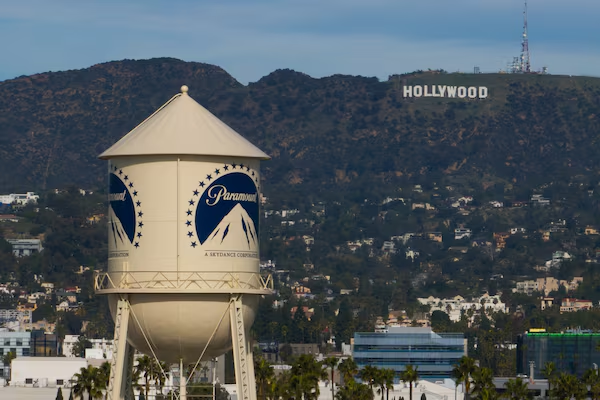
On February 27, 2026, “Scream 7” opened in theatres and grossed over 100 million dollars at the box office worldwide. Two weeks earlier, “Wuthering Heights,” the newest remake of the classic love story released to over 194 million dollars worldwide. Hollywood studios, led by major studios like Disney and Paramount Pictures, are producing sequels, reboots, and adaptations at a record pace.
At first glance, it might seem like creativity is a dying skill in Hollywood. When familiar titles constantly outperform new, fresh ideas, it is easy to assume that creativity has been replaced by repetition. However, creativity is not dead. It is being overshadowed by financial incentives that pay for predictability over originality.
Producing major films typically run over hundreds of millions of dollars in budget, and studios expect big and profitable returns. Sequels, remakes, and adaptations already have a built in fanbase, and a certain familiarity that original stories cannot guarantee. Because audiences can recognize the characters or the brand behind the film, these projects are also much easier to market and are more likely to generate a higher amount in box office returns.
In 2025, nine out of the top ten highest grossing movies worldwide were sequels, remakes, or adaptations. This included films such as “Ne Zha 2,” “Lilo and Stich,” and even “A Minecraft Movie.” The only exception, was “F1: The Movie,” which was still adapted from a sport, but told an original story with original characters and a new storyline. This trend shows that original movies do still exist, but rarely reach the same box office hype, leaving creative, new storytelling overshadowed by familiar franchises.
Audiences aren’t rejecting new major ideas, they’re just pivoting to what is most available to them. When theaters are packed with franchise movies, and original movies get limited showtimes, people naturally gravitate to what is easier to find.
Streaming has also changed things. Studios are often sending their riskier, more creative projects straight to streaming platforms, where the expectations are much lower. While this gives a place for original movies, it also means they won’t get the same cultural impact as the big theatrical releases. This gives a certain stigma to the audience that “big movies” equal franchises, and “small movies” equal original movies.
Directors have been calling out this problem for years. Christopher Nolan, who has directed films such as “Inception” and “Interstellar,” even stated in an interview with Associated Press that one of the best parts of going to the movies is “seeing the trailer for a movie you’ve never heard of, a something you haven’t seen or haven’t seen in a long time – something new something fresh…” He also explained that this is essential for “a healthy ecosystem in Hollywood” His point makes it clear that even directors want studios to take more creative risks instead of relying on the same formulas
Another issue is AI. Some studios such as Lionsgate have already stuck deals with AI startups to cut costs and speed up production. Visual effects companies are also starting to use AI tools to do basic tasks that artists used to do by hand, such as cleaning, tracking and background fixes. While this can make movies faster and cheaper to produce, many directors worry that studios will use AI as a shortcut instead of supporting real creative teams.
The real crisis is that Hollywood hasn’t run out of creativity. If studios invest more time and resources into original storytelling and audiences commit to supporting those films, the industry can then create space for both blockbuster and original films at theaters. Hollywood isn’t out of original ideas, it’s too scared to take risks on them.